New Mexico facilities · 2025 research
New Mexico plumbing gaps extend beyond rental housing
New Mexico’s estimated shortfall in complete plumbing facilities was concentrated in owner-occupied homes in 2025. The American Community Survey counted about 8,301 occupied homes without complete plumbing, including 6,890 owner-occupied homes and 1,411 renter-occupied homes.
Those estimates put homeowners firmly inside the basic-housing-services question. They do not identify which homes need a particular repair, who qualifies for assistance, or whether a home violates a building code. The underlying survey is a statewide description of facilities, not an inspection record. 2025 ACS plumbing table
The distinction is relevant to an existing repair system. Housing New Mexico’s homeowner rehabilitation program supports essential improvements for eligible households, including work addressing sanitation and substandard conditions. Its current program page also identifies closed waiting lists in several service areas. The ACS figures cannot measure those queues or establish whether the same homes appear in both sources. Housing New Mexico program information
Missing facilities are not one interchangeable category
The Census Bureau’s definition of complete plumbing requires hot and cold running water and a bathtub or shower. It is not a measure of drinking-water safety, reliable supply, sewer connection or septic-system condition. The ACS stopped including a flush toilet in its complete-plumbing definition in 2016. 2025 subject definitions
Kitchen facilities are measured separately. An estimated 10,038 occupied New Mexico homes lacked complete kitchens in 2025: 6,626 owner-occupied homes and 3,412 renter-occupied homes. The Census definition requires a sink with a faucet, a stove or range, and a refrigerator. Missing any component places a home in the incomplete category. It does not mean that every such home lacks every appliance. 2025 ACS kitchen table
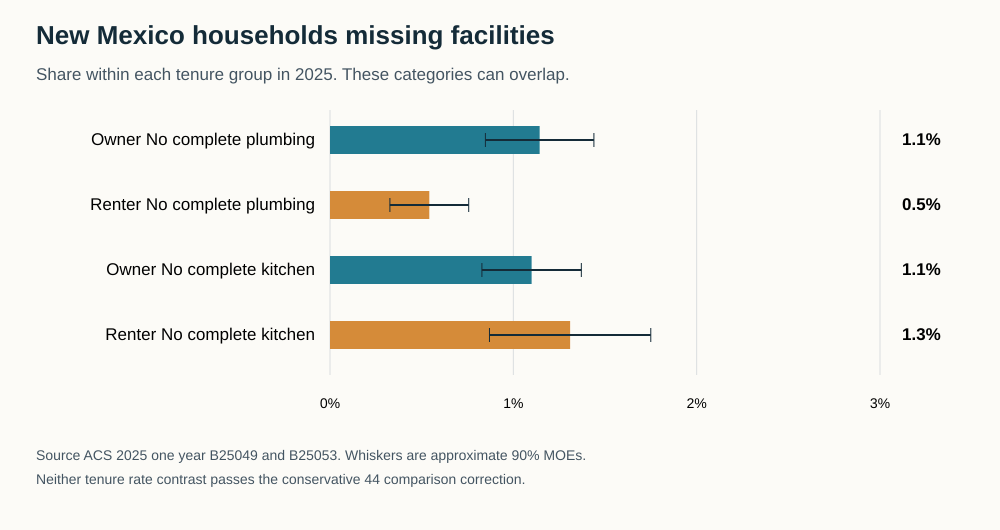
Owners are the larger tenure group: 602,506 households, compared with 260,504 renter households. On those denominators, the plumbing estimates were 1.14% of owners and 0.54% of renters. Kitchen estimates were 1.10% and 1.31%, respectively.
The rate comparisons need restraint. Approximate 90% margins of error are 0.30 percentage points for owner plumbing and 0.21 for renter plumbing; for kitchens, they are 0.27 and 0.44 points. Neither tenure-rate contrast passes the conservative adjustment across all 44 comparisons retained from this analysis’s four-state exploration. The kitchen point estimates, in particular, should not be presented as an established renter disadvantage.
| Group / category | Estimated units or households | Denominator | Share ± 90% MOE |
|---|---|---|---|
| Owner occupied Lacking complete plumbing | 6,890 | 602,506 | 1.14% ± 0.30 pp |
| Renter occupied Lacking complete plumbing | 1,411 | 260,504 | 0.54% ± 0.21 pp |
| Owner occupied Lacking complete kitchen | 6,626 | 602,506 | 1.10% ± 0.27 pp |
| Renter occupied Lacking complete kitchen | 3,412 | 260,504 | 1.31% ± 0.44 pp |
Scroll the table horizontally on smaller screens. Full-precision values and definitions are in the chart-data CSV and evidence ZIP.
Why adding the totals would mislead
Adding 8,301 plumbing cases and 10,038 kitchen cases produces 18,339. But that is not an estimate of 18,339 different households. A home missing both facilities appears in both tables.
The published tables do not supply the overlap. Using their point estimates and keeping owner and renter groups separate, the number missing at least one of the two facilities could range from 10,302 to 18,339. The lower endpoint assumes the maximum possible overlap within each tenure group; the upper assumes no overlap. These are arithmetic bounds on the published point estimates, not a confidence interval or a statistically certain minimum.
That limitation affects how the figures can be used. They describe two kinds of housing need without delivering a single, deduplicated rehabilitation caseload. A program budget, address-level repair list or eligibility forecast would need additional information.
A current baseline rather than a new crisis claim
New Mexico’s facilities deficits are not a newly discovered topic. Housing New Mexico’s 2025–2029 consolidated planning materials already examine housing conditions. This analysis adds a 2025 tenure breakdown and makes the unknown overlap explicit. It does not establish deterioration, identify affected tribal communities, or attribute a deficit to a landlord or public agency.
The figures are survey estimates. The owner plumbing count, for example, has a published 90% margin of error of 1,786 homes; the renter count has a margin of 562. Census also reports that the 2025 interruption in data collection affected precision. The defensible takeaway is not a precise repair queue: basic facilities gaps remain part of the owner-occupied housing picture as well as the rental one. Census collection note
Methods and interpretation limits
These are 2025 ACS one-year household cross-sections, not annual trends or national rankings. The collection interruption and changed disclosure/release procedures are disclosed in the archived methodology. Derived 90% margins are approximate and do not capture all nonsampling error.
The complete 44-comparison family is retained. Maine electricity, oil and utility-gas tenure contrasts pass the conservative adjustment; neither New Mexico facilities rate contrast passes. Individual chart intervals are not simultaneous intervals.
This research remains separate from the site’s five-year structural housing score and does not modify the score, calculator or database.
The 10,302–18,339 union bounds are arithmetic on tenure-stratified point estimates, not a confidence interval, assured minimum or linked household caseload. Plumbing definitions do not measure water quality or septic performance. Allocation context can use all housing units, including vacant units.
Read the full archived methodology. The evidence ZIP preserves frozen source files, source provenance and reproduction scripts.
Sources and context
Data and chart downloads
The evidence download is shared with the related studies that use the same source files. Keep the original folder layout when extracting it. Source and sensitivity records retained for reproducibility do not constitute additional published stories.